Monday, February 18, 2008

Presidents Day and Politics.

I have never been a member of a political party. But as far back as I can remember I have continued to be an observer of political issues.

As a Georgian, I loved and voted for Jimmy Carter both times for President. I did not vote for Bill Clinton but respected him as a brilliant speaker and a gifted politician and a patriot. However, I do believe a person's personal life is important, and his affair in the oval office with a girl only a few years older than his daughter is more than a personal affair.

The fact that the Republican politicians were looking for any and all "evidence" against the Democratic President William J. Clinton was a sad episode in our history. Equally as tragic is the relentless and hate filled Democratic public attacks on Republican President George W. Bush.

The tragedy of "gotcha" politics compounds the problems in a world where the radical Muslims in many Middle Eastern nations have openly declared their intentions to destroy this nation as well as all of Western civilization. The academic "Western Civ must Go" slogan of the 60's has been taken up seriously by our suicidal enemies as well as the thoughtless "blame America" people.

My father died when I was nine. Papa was a devout Christian thinker, whose faith and life had a profound influence on me. So politics has always taken a back seat to my Christian commitment. But I was raised by a mother who was an avid reader and took a keen interest in politics and was quite vocal about her views. She could be (and was) quite opinionated!

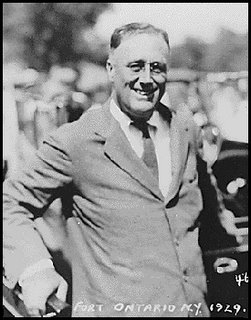
For President's day 2008, I will write about politics in the 1930's. Mama was not as big an admirer of President Franklin D. Roosevelt as were many of the people in our town who voted for him for a second term saying "he took the wrinkles out of my belly." They then voted for him for a third and fourth term so as to "not change horses in the middle of the stream" during World War II.


While others were praising Roosevelt for the eight-hour day, Mama was not reluctant to point out that some people could not "see an inch from their noses" and see the long view with the government taking over the lives of the individual citizens. Mama felt she was seeing the long view for the common good rather than individual issues for personal gain.

Mama was also suspicious of the Workers Unions. She thought they would create as many problems as they solved. And last, but not least, she disagreed with Roosevelt's Alcoholic beverage lobby support and work of repealing the eighteenth amendment and again legalizing (and therefore popularizing) alcoholic drinks. Today the powerful muti-million dollar Alcohol Insustry has bought the approval of a large percentage of our people and the silence of all but a few.

Certainly legalizing Alcoholic Beverages has not solved the alcohol problem. Alcoholism is a major problem in our society, We now have children who are alcoholics as well as a holocost of "Driving Under the Influence" deaths. Yes, Alcoholisn is a disease. But unlike the some otehr diseases, thanksfully there is a known cure. Persons suffering from cancer or AIDS who only hope to find such a sure cure?

Mama believed (and stated ) that these positions negated whatever other good President Roosevelt had done. I was a child, but I remember some of the arguments in favor of legalizing alcohol -- that the revenues would buy school books to educate the children (the same arguments used more recently to legalize gambling) -- and that the government could then "control" alcoholic beverages. Thus legalization would do away with speak-easies and the evils of the bootlegging of "deadly liquor brewed in old rusted auto parts by the Snuffy Smith types in the hills and backwoods of nowhere." The liquor dealers and pro-liquor politicians knew how to phrase their arguments then as now to influence the thoughtless. I was a small child at the time but read the daily newspaper and heard the discussions on the neighborhood front porches.

It is interesting to have lived long enough to see that politics has been alive and working for a long time.

Breast Feeding

Breast Feeding. In Headline News several years ago, I read that Actress Salma Hayek's daughter Valentina Paloma turned one year old. But like other Mothers before her, Heyek was loathe to give up breastfeeding as Valentina was thriving so beautifully.

Many mothers learned, as I learned when I was breastfeeding my first baby, it is good to wait until the baby can drink from a cup, rather than to wean him/her to a bottle from her/his mother's milk and then from the bottle to a cup.

As most of us have been taught, there are very good reasons to breast feed: It is natural and the very best nutrition for babies, as well as important for bonding and economics, just to name a few.
And most importantly, to remember the first milk in the breast, colostrum is the medication and nutrition the newborn baby needs.

Salma Hayek, a spokesperson for UNICEF, discovered another good reason to keep her breast milk flowing during her visit to Sierra Leone in September 2008.

In an effort to encourage West African women to breastfeed, the actress/humanitarian offered a sick baby boy the greatest gift of all -- milk from her own breast. After she's fed the baby, it was suggested that Hayek had been disloyal to her own baby by sharing her milk? Hayek decides that she has done something good for both babies. "My baby would be very proud to be able to share her milk," she says. It seems that Hayek's unselfish giving of her breast milk is a bit of a family tradition.

She tells the story of her own great-grandmother breast feeding a stranger's hungry child on a street in Mexico. It's a beautiful story made more so by Hayek's own gift to a hungry little baby.

The question asked at the end of the story asked: If you ever found yourself in a position to do so, would you breastfeed another woman's child? Would you allow your child to feed at another woman's breast? My answer is “yes” to both questions. Of course I would!

This story reminded me of a story in my life I had not thought about for a long time. My sister-in-law, Ruth Mitchem Baird and I were pregnant at the same time. My daughter Janice was born on June 3 and her daughter Gail was born on June 14 of the same year.

One day three month old Janice and I were visiting my mother while my mother was baby sitting Gail for my sister-in-law who had a doctor’s appointment. For some reason Ruth was delayed past Gail’s regular meal time. When Gail began to let us know it was getting past her dinner time, Mama turned to me and said, “You can feed her.”

I was young and frankly shocked and looked at my Mother questioning? “Sure it is alright and a good thing to do,” my wise mother assured me. So my beautiful little neice Gail was happy to accept milk from my breast while her mother was away and I had plenty of milk for Janice’s next feeding.

Monday, February 11, 2008

Life with Wings

Life With Wings
Cecil B.DeMille said he was in a canoe in Maine one summer day just drifting through the water in a shallow place near the shore. He could see the bottom of the lake and noticed it was covered with water beetles.
One of the water beetles crawled up on a canoe, fastened its feet in the gunnels and died.
Three hours later, still floating in the warm sun, DeMille said he witnessed a miracle. The shell of the water beetle cracked open and a tiny head emerged. The wings unfolded and finally a beautiful dragon fly with iridescent body and gossamer wings left the dead carcass and sailed across the surface of the water, shimmering in the afternoon sun…going further in a half second than the water beetle could crawl all day long.
The dragonfly sailed across the surface of the lake.. But the water beetles below, unaware of the miracle of metamorphosis, could not see it. .

DeMille said, “Do you think God would do that for a water beetle and not do it for you and me?"

Have you ever known the feeling of being lifted above ordinary limitations? Not just doing the best you can “under the circumstances” but allowing God to get you out from under the circumstances that would hold you. God is able! God is able to lift us up and over the limitations placed on us or the limitations we place on ourselves.

I sat on Sunday night with a congregation listening to Charles Shaw (a great preacher) give a sermon. He told about an imaginary conversation someone had with an ordinary looking worm crawling down the road of a busy city. The worm was "out of place" but told the man, "Don't stop me. I'm going to get my wings."

This is the poem I wrote:

Life With Wings

God made the butterfly
And I…
Stand on earth
And watch it fly
And see that God
Has fashioned wings
For even earthbound
Creeping things!
I know that God
Intended wings
For you and me
Oh! My heart sings!
I’ve found my wings.
And even I…
Can over circumstances
Fly!

by RBS Copyright by RBS in 1973

Thursday, February 07, 2008

Gladys and Lavay's 50th Wedding Anniversary

Gladys and Lavay's 50th Wedding Anniversary
Sunday June 21, 2007 - 2- 4 PM

A few Comments of Memory and Appreciation.
Congratulations to Gladys and Lavay on their 50th wedding anniversary.

Lavay is my nephew and the oldest of my parents' twenty grandchildren, so he had his own special place in the Baird family. (picture at right is Lavay at 2 and Ruth at 8)

After Lavay and Gladys's marriage, Gladys also became a vital part of our large family. I am especially appreciative of the fact that Lavay and Gladys visited (and later brought their children to visit) his widowed maternal grandmother regularly in her old age.

Gladys and Lavay and their children also can always be counted on to participate and attend Baird family reunions, funerals and weddings when possible.

Lavay is the only child of my sister Louise and her husband Ernest McCullough. Louise was the last of my three sisters and five brothers to die. So as his last aunt, who knew him as a child, I will write a few memories of Lavay's childhood.

Lavay came into the world with a ready made and large family of fans. His mother Louise, as the oldest daughter, was called "Sis" by the rest of us. Sis, the perfect lady, took an interest in her younger siblings and tried to teach us proper manners, not always with success. Nevertheless, she had a special place in the heart of each one of us. I will miss her as long as I live!
. Lavay was one of the pastors to give a eulogy at his Grandmother Baird’s funeral.

Lavay's dad was killed in a tragic robbery when Lavay was a baby. Lavay may know more of the details from his mother than I, but my understanding is that Ernest was robbed of his money by two brothers and killed.
The two Hulsey brothers received the death penalty and were electrocuted for this horrible crime.

One of the sad memories of my childhood is the sight of my grieving sister, Louise fainting and almost falling as she is being escorted to a car supported on each side by her two older brothers (Wilson Grice and William Bogan) to go to the first of the cars lined up in front of our house on 32 Hazel Street to go to her husband's and the father of her baby's funeral.

When Lavay was less than two, he contracted polio in an epidemic among babies and young children. The "new" disease was affecting many babies at that time and was introduced to us as "Infantile Paralysis.

"The treatment then was to isolate the child with polio because of fear of contagion. I remember my mother being furious with the medical people at the hospital because they took him screaming away from his mother and would not let her stay with him. The family story is he never stopped crying and his strong voice could be heard crying loudly enough to be heard all the way to the waiting room.

Apparently it helped to develop his lungs to prepare him for his later calling as a preacher of the Gospel. So I suppose Mama finally forgave them. After they brought Lavay home, Sis made up for any trauma he may have endured as she lovingly bathed and massage his legs every night.

Sis was reluctant but Mama loved to tell stories of the "cute" things Lavay said as a handsome and bright little boy who learned to talk early. Mama told about how Lavay, as a toddler, slipped out of his mother's reach as she was giving him a bath, ran "stark naked" out the door to the back porch and yelled to Mrs. Horning, a neighbor, "Look Horning, I'm barefooted."

Louise and Mama took joy in the fact that Lavay, in spite of his paralyzed leg, learned to do exceptionally well everything any other boy could do, including bicycling and climbing trees.

Lavay's grandfather (my father), Wilson Baird, became ill with heart disease and died in 1932 when Lavay was only three. Family members told me how, as a thoughtful man who loved all children, Papa gave special love and attention and prayer for Lavay as his first grandchild as well as to the other three grandchildren (Marian Loyd, Leon Loyd and Bobby Baird) who were toddlers and the only grandchildren born before my father died.Papa was bedridden over a year before he died.

My sister Vera told me how several 0f the little children were one day beside Papa's bed playing when she went into his room. She said, Papa, "I'm so sorry, are they bothering you?" he replied, "Let them stay with me, we are having an important conversation."
.
I was six when Lavay was born, and like most little girls, was happy to be invited to go along with him and his mother, and hopefully be a little help on their frequent visits to see his paternal grandmother, Mrs. Steele and other of his father's relatives who lived in Covington - about three miles away
I also traveled with Louise and Lavay by taxi and street car for his regular exams and treatments at Scottish Rite Hospital when the hospital was located at the end of the trolley line in Decatur. We got off the trolley car and walked a few blocks to the hospital.

I am happy to join with others of my family and with friends to congratulate Gladys and Lavay on reaching the 50th anniversary milestone! Their Christian life and the Christian life and witness of all three of their children continue to be an inspiration to all who know them.

Monday, January 28, 2008

Bed and Bath in the 1920's and 1930's


I would like to hear from BLOGGERS of my generation (age 80 and more) about their memories of life in the early thirties. My father died when I was nine, and so I was raised by a widowed mother and my memories may not be typical of everyone in the Southern United States.

I never had a room of my own. Never even a bed of my own. After Papa died, we moved to a smaller house. I slept in the bed with my mother. There was also a single bed in this bedroom and my sister, Mary, slept there. My brothers, Charlie, Tom, and Jack, slept in a room across the hall. My youngest brother, Jack, was five years older than I. My sister, Mary, was ten years older; so I was almost raised alone as far as sibling playmates was concerned. (The picture to the left is of my nephew Lavay McCullough,(age 2)and of me, Sarah Ruth Baird at 8. Lavay's Dad had been killed as a young man so when the picture was taken, each of us had lost our Dad.

Although we were poor, we were happy children, loved and cared for by our mothers, and in Lavay's case, also a grandmother who adored him. In my case, my older sister Louise, Lavay's mother loved me devotely also. We were also surrounded by other caring and capable adults. We lived in a neighborhood of hardworking friendly adults and children.

So when I mention we were poor, it was not "poverty" in the sense of poverty today. It is said that "poor" was proud (not un-Christian pride, of course) in the South after Sherman's successful march through Georgia and all the way to the sea. Much of the South was left in ashes that finally ended the War between the States. At least "poor" meant you were honest and not a "carpetbagger" or a bootlegger.

In a world of class, as well as racial divisions, my mother told me, "You came from good stock." She was pleased to then tell about her grandmother who traced her lineage back to the Revolution and her maternal grandfather who had been a prosperous land owner and a Methodist preacher.

And we, as well as nearly every Southern family had a story of some brave woman or child facing the soldiers from the North, seemingly bent on burning the South to the ground and thus ending the horrible war. In November, 1997, I read a part of our family history when a woman ancestor faced Northern soldiers, who were about to torch their house. She let the Yankee soldiers know that her husband was also a member of the Masonic lodge. Apparently this was a common ground respected by both North and South .

In our small town , most of the people worked for Bibb Manufacturing Company. Most were hard working and glad to have a job of any kind. It took all the members of the family working to have enough income to survive. They lived on their meager incomes and helped one another in times of emergency. Almost everyone we knew had about the same income and opportunities. If someone was out of work or sick, the neighbors collected money for them or made up a "pantry shower." There was no sick leave and none expected nor other such benefits.

My mother was hardworking and resourseful and we always seemed to have plenty to eat and to share and most of what we needed. I do remember that on many occasions Mama was instrumental in collecting food supplies (pantry showers) for neighbors who had to be out of work because of sickness or other problems. Mama also lent money (without interest) to neighbors between paydays.

I remember that there was one man in the neighborhood who would make loans with interest to his less fortunate neighbors. This was considered unneighborly and un-Christian.

The salary for a full week's work was $9.90 for some and $10.80 for other jobs. I remember people jokingly saying, "If you can't make $10.80, $9.90 will do." We did "make do." To put this in focus. The overseers in the Cotton factories were paid about $100. weekly.

In the bedroom where I slept with my mother and sister, there were a couple of rocking chairs and some "straight" chairs because this was also a sitting room. The parlor or "front room" was across the hall in our house before my mother converted it into a bedroom to accommodate "boarders". This is another story.

Before going to bed, we sat around the heater at the "fireplace" and talked, or in my case, listened. I was a painfully shy child. If one decided to go to bed, it was no problem. One just went over in a corner or behind a door, undressed and put on night clothes. I remember warm flannel gowns.Today we remind our children to go to the bathroom before going to bed. In those days a "slop jar" was brought into the bedroom, and the children were reminded to"go to the slop jar before you go to bed."

Sometimes this vessel was called a "chamber pot" or just a "chamber." It was not my regular job, as I remember, but I was often told to "bring in the slop jar" or sometimes "go bring the chamber in." My mother usually did the more unpleasant job of taking it out, emptying it in the commode which was in a bathroom off the back porch, and washing it out.

The bathroom had a large footed bathtub and a commode. The "out house" in our community was before my time. However, this indoor plumbing had been added to one end of the back porch after the house was built (this smaller house on 45 Hazel Street being one of the older ones we moved into after my father's death).

At one point a gas heater was put in the bathroom, but that may have been in my later childhood. I do remember that sometimes, in cold weather, we brought a large wash tub or a smaller "foot tub" into the warm kitchen or bedroom to take a bath. The bathroom was not as well sealed as the other rooms, so it was not suitable for bathing in very cold weather. We sometimes took sponge baths. This involved bringing a large “washpan” of warm water with cloth, soap, and towel into some private corner of a room. Every part of the body was thoroughly washed and rinsed but not all at the same time. Mama believed "cleanliness was next to Godliness."

My earliest memory of bedding were sheets that were made at home
with seams down the middle. I think that textile looms that would weave cloth 54 or 60 inches wide were developed much later. I remember a few straw mattresses. These were homemade mattresses filled with straw to put on beds. I remember such a mattress on a small odd-sized bed in one of the rooms. Probably there were no mattresses that size on the market. The other mattresses were factory-made, cotton-filled mattresses.

We were fortunate to also have feather bed mattresses to put on top of all the cotton mattresses. Mama was very resourceful. Feather mattresses were made at home. One would buy pillow ticking cloth (pillows were made at home also), sew it the length and width of the bed and fill it with feathers. On a cold winter night it was good to sink down in a bed of feathers and under the weigh of numerous homemade and home-quilted quilts. In the 1930's we called them "feather beds" and put them on top of the cotton mattresses. This added to the bed-making time every morning. One had to fluff up the feathers and smooth it out, often turning it over, and frequently taking it out in the sun to“air it out."

When innerspring mattresses were added to the market, most people were glad to retire the feather bed to history.

Homemade quilts? We had large stacks of them, home-pieced and home-quilted by Mama and the women in the neighborhood. In cold weather one was weighted down under warm quilts. In summer, when company came, quilts were folded on the floor to make mattresses for the children and sometimes for adults to sleep on after all the beds were filled.

We children loved these temporary beds. To make the quilts, quilting frames were hung from the four corners of the ceiling of our bedroom and drawn up at night. I have slept many nights with an unfinished quilt suspended above. Neighbors would come to visit and help with the quilting. Any unoccupied house in the village was often put into service for quilting bees. The quilting frames were hung from the ceiling, and six to eight women would take a chair and sit on all sides of the quilt, making fine stitches in a quilt pattern that one of them had drawn.

There was much talk and laughter as these women visited while working on a quilt. The younger children played at their feet, and the older children were in and out of the house.The advantage of the empty room was that the quilt would not have to be lifted up at night and walked around in the daytime. In the evenings Mama would cut and sew various patterns for future quilting. The children would play around and sometimes be allowed to make a few stitches and were complimented if they could manage small stitches. If the stitches were too long, the mother would remove the stitches, often after the child left the room. Everyone took pride in fingers nimble enough to make practically invisible stitches.

I was allowed to make a few stitches occasionally but was not often invited to quilt, so I assume my stitches were far from invisible.
Thursday, January 24, 2008

High School in the 1930's


Ruth Baird Shaw, Clara Daniel, Lenora Farrow Mills, Gladys Newnan.

People keep asking about reports cards in Public Schools during the late 1920's and 1930's. In our Georgia small-town school, we were graded A, B, C, D or F. I do not remember anything about the grading system or how I scored in First and Second grades. I do know that I never received a D or an F and do not remember many A's. I was generally a B student. I usually sat quietly and went unnoticed in class, speaking only when spoken to.

This post could be entitled "The difference a kind teacher makes." One of my teachers. Miss Willie Hayne Hunt, tried to encourage me by telling me I was probably the " best mathematician that ever walked in the school door." This kind of remark from a teacher made a big difference in the way I saw myself as a student. I began to find algebra and geometry problems not just easy but fun to do.

In several posts I have spoken of myself as a "painfuly shy child." On the other hand I told in another post about being chosen to walk up on the large stage in the school auditorium to tell a Bible story one morning in "Chapel", our three times a week school assembly time. So perhaps my "painfully shy" period started after first grade. I read recently that nearly one third of the population considers themselves to be shy.

The Ninth Grade was the last grade offered in our community school. If one desired to attend school after the ninth grade, he/she had to pay tuition and find transportation to Covington, our Newton County seat, to finish tenth and eleventh grade and receive a High School Diploma. So the Ninth Grade was the end of school for many students in the thirties if they did not have to stop and find a paying job earlier.

My widowed mother somehow managed the tuition cost for me to attend Covington high School and another small transportation fee to Louise Walton, a girl in my class who had bought a car. I rode with Louise to Covington every school day for a full semester. Alas, she dropped out. (Perhaps High school students then as now may spend more time with their cars than their books!)

With no transportation to Covington after the first semester in the tenth grade, I then transfered to Livingston High School, a county High School. I walked with 2 other girls and a boy the mile or so every morning to the far end of our community to catch the school bus to ride to the country school where I finished the tenth grade with only two units left to graduate.

One of the things I remember about Covington High School in the semester I attended was an assigment to write a story of fiction. I remember working on the story but do not remember anything about it. It was basically a rearrangement of something I had read (which is probably why I do not remember anything about the story.) When we take short cuts or cheat on anything, we only cheat ourselves.

Another day while i was a student at Covington High, we went to Chapel where someone introduced a blind and deaf lady and illustrated how she communicated. This memory is too vague for me to be sure of details. I keep thinkig it must have been Helen Keller and her teacher? Did Keller and her teacher visit High Schools In Georgia in 1938? Who else could it me? I believe that the famed Annie Sullevan, Helen's first teacher died in 1936. Polly Thomson, assisted Sullevan later and became became Helen's teacher after Annie Sullevan's death.

I especially remember one of the teachers at Livingston High School, (the school where I transfered after my friend with a car left Covington High). The unforgetable teacher at Livingston was a widow in perpetual black dress. She was always openly counting the days until the end of the school year. I do not know how long she had been a widow, but this thin and sad looking lady in her "widow's weeds" each day would tell us how she was counting the days until the end of her days as a teacher. Then she would remind us how many days were left in the school year. She called herself the "walking calendar."

Post Script: The above picture was taken in 1943. Porterdale establised a High School in 1940. Older students were allowed to attend. My husband went back to classes and graduated in 1942 and i in 1943. We had two precious little girls at the time I graduated. But I needed only two units so it required little of my time.

Interestingly, this High School work from three schools proved to be adequate preparation for college work when I was finally able to began my delightful "hobby" of college classes here and there in my "spare time."

Thursday, January 17, 2008

Pennies From Heaven

>
Most of us have heard stories that picking up a penny from a walkway brings good luck, is a gift from angels, etc. This story about finding a penny is another twist to the story.
Arlene and her husband were invited to spend the weekend at the husband's employer's home. Arlene was nervous about the weekend. The boss was wealthy, with a fine home on the waterway, and cars costing more than her house. The first day and evening went well so both Arlene and her husband were delighted to have this rare glimpse into how the very wealthy live.

The husband employer was quite generous as a host and took them to the finest restaurants. Arlene knew she would never have the opportunity to indulge in this kind of extravagance again, so was enjoying herself immensely. As the three of them were about to enter an exclusive restaurant that evening, the boss was walking slightly ahead of Arlene and her husband. He stopped suddenly, lookingdown on the pavement for a long, silent moment. Arlene wondered if she was supposed to pass him. There was nothing on the ground except a single darkened penny that someone had droppedand a few cigarette butts.

Still silent, the man reached down and picked up the penny. He held it up and smiled, then put it in his pocket as if he had found a great treasure. How absurd! What need did this man have for a single penny? Why would he even take the time to stop and pick it up?

Throughout dinner, the entire scene nagged at Arlene. Finally, she could stand it no longer. She casually mentioned that her daughter once had a coin collection, and asked if the penny he had found an been of some value.

A smile crept across the man's face as he reached into his pocket for the penny and held it out for her to see.. She had seen many pennies before! What was the point of this? 'Look at it.' He said. 'Read what it says.' She read the words ' United States of America. 'No, not that. Read further.' 'One cent?' 'No, keep reading.' 'In God we Trust?' 'Yes!' 'And?' 'And if I trust in God, then the name of God is holy, even on a coin. Whenever I find a coin I see that inscription.

In God We trust is written on every United States coin, but we never seem to notice it! God drops a message right in front of me telling me to trust Him? Who am I to pass it by? When I see a coin, I pray. I stop to see if my trust IS in God at that moment. I pick the coin up as a response to God - that I do trust in Him. For a short time, at least, I cherish it as if it were gold. I think it is God's way of starting a conversation with me.
God is patient and pennies are plentiful! When we are out shopping and find a penny,pick it up. If we have been worrying and fretting about things we cannot change, read the words, "In God We Trust," and smile. Yes, God, I get the message.

Wednesday, January 09, 2008

Canning in the Summertime.

In my early childhood (late 1920's) there were no electric refrigerators and, of course, no freezers nor frozen food. In the summertime ice wagons came daily to sell ice for the ice box to keep food cold.The only way to preserve surplus food was canning or drying.

During the summer our large iron stove would have to be fired up with "stove wood" to make fig and pear and peach perserves and apple jelly. Mama would dry apples and peaches for winter pies and make applesause, peach and pear perserves and pickles.


In my early teens we finally got an electric refrigerator. I remember one of our neighbors who was visiting, when the refrigerator was humming, she said in awe, "It's making more ice."
We had a beautiful little peach tree in our back yard near a street where little boys passed by and some of the little boys could not resist the temptation to pick some of the peaches. My mother loved children, including little boys. She had
five sons, two of which were grown and married in my early memories. So Mama would go out and kindly tell the little boys to help her watch for the peaches to get ripe and to please let the peaches stay on the trees until they were ripe and she would share with them.

Nevertheless, "boys will be boys" as they say. By the time the peaches were ripe , there were usually few peaches left on the tree. But Mama always found enough, on the yard side of the little tree, to make a few quart jars of some of the best peach pickles I ever ate.

My mother would also make a year's supply of jelly...by taking apple and other fruit and peach or pear peelings to boil and strain the juice. She also canned green beans, tomatoes and vegetable soup in large quantities.

I have seen Mama stand at the stove canning and preserving summer fruits and vegetables with sweat pouring off her face. She would have a towel around her neck
like a scarf to wipe her face as she stood at the hot stove.

This would make the whole house hot. So we escaped to the porch or yard as often as possible, as did all the neighbors.

One of the advantages was that with no television and no air conditioning one got acquainted with neighbors. As long a Mama lived, she had neighbors dropping in to visit, even in the television and window fan era in the fifties, sixties, and early seventies. Mama, born March 6, 1885, died December 7, 1973. My father had died in 1932.

Thursday, January 03, 2008

The Future Starts Tomorrow.

1. The nicest thing about the future is that it always starts tomorrow.

2. Money will buy a fine dog, but only kindness will make him wag his tail.

3. If you don't have a sense of humor, you probably don't have any sense at
all.

4. Seat belts are not as confining as wheelchairs.

5. A good time to keep your mouth shut is when you're in deep water.

6. How come it takes so little time for a child who is afraid of the dark to
become a teenager who wants to stay out all night?

7. Business conventions are important because they demonstrate how many
people a company can operate without.

8. Why is it that at class reunions you feel younger than everyone else
looks?

9. Scratch a dog and you'll find a permanent job.

10. No one has more driving ambition than the boy who wants to buy a car.

11. There are no new sins; the old ones just get more publicity.

12. There are worse things than getting a call for a wrong number at 4 AM .
It could be a right number.

13. Think about this..., No one ever says "It's only a game." when his team
is winning.

14. I've reached the age where the happy hour is a nap.

15 Be careful reading the fine print. There's no way you're going to like it

16. The trouble with bucket seats is that not everybody has the same size
bucket.

17. Do you realize that in about 40 years, we'll have thousands of OLD
LADIES running around with tattoos? (And RAP music will be the Golden
Oldies!)

18. Money can't buy happiness -- but somehow it's more comfortable to cry in
a Mercedes than in a Yugo.

19. After a certain age, if you don't wake up aching in every joint, you are probably dead.

Wednesday, January 02, 2008

Mrs Obama and Britian's Queen

Ruthlace is not a political Web Log but I was interested in Luke Baker's recent article entitled "Michelle Obama finds a new friend in Britain's Queen."

It is highly unlikly that Mrs. Obama is the first "First Lady " of the United States to be a "friend of Britains' Queen?"
But Baker goes on to report ;" "If Michelle Obama ever needs a place to stay in London, she could do worse than call on Queen Elizabeth. The two women met at the G20 summit in London in April and have kept in touch since then, royal sources said on Sunday.

When Michelle Obama made a private visit to the British capital last week with daughters, Malia, 10, and Sasha, 8, they were given a private three-hour tour of Buckingham Palace."

Meeting the Queen is a complicated thing, we are told. You have to curtsy, you can't extend a hand before she extends hers, you can't pick up food before she does, and you definitely, most certainly, never, ever are allowed to attempt to hug or kiss her. Which is why it caused quite the hilarious stir yesterday across the pond when Her Royal Highness half-embraced Michelle Obama. Nearly the entire nation simultaneously snarfed their English Breakfast. And then, the unthinkable happened: Michelle hugged her back.

A breathless eyewitness explains to the Daily Mail:

"There was a bit of a bottleneck as all of the leaders filed out so the Queen started chatting to Michelle Obama. She appeared to look up at her and make a comment about how tall she was. As she did, she put her arm around Mrs Obama and rested her gloved hand on the small of her back. Almost simultaneously, Mrs Obama put her arm around the Queen's shoulders rather more firmly. The pair then looked at their feet and appeared to be discussing their shoes. The Queen then dropped her arm and, a few seconds later, Michelle did the same. The entire exchange lasted around eight to ten seconds but was absolutely extraordinary. The people of England, certainly would not want to offend the first African President and First Lady of the United States.

"According to " sources," the queen and Michelle Obama have exchanged letters and spoken by telephone since that first meeting. The visit last Wednesday was organized as a treat for Sasha, who turned 8 that day.

Despite their age difference, the two women are said to share a number of interests, including the countryside, gardening and clothes.

'It's a positive thing for relations between the two countries that the royal family and the president's family get along so well,' the sources said."

(Reporting by Luke Baker; Editing by Matthew Jones)