 Bed and Bath in the 1920's and 30's. My family keeps asking me to write more about life when I was a child. I would like to hear from BLOGGERS of my generation and about their memories of life in the 1920's and thirties. My father died when I was nine, and so I was raised by a widowed mother. My memories may not be typical of everyone in the Southern United States.
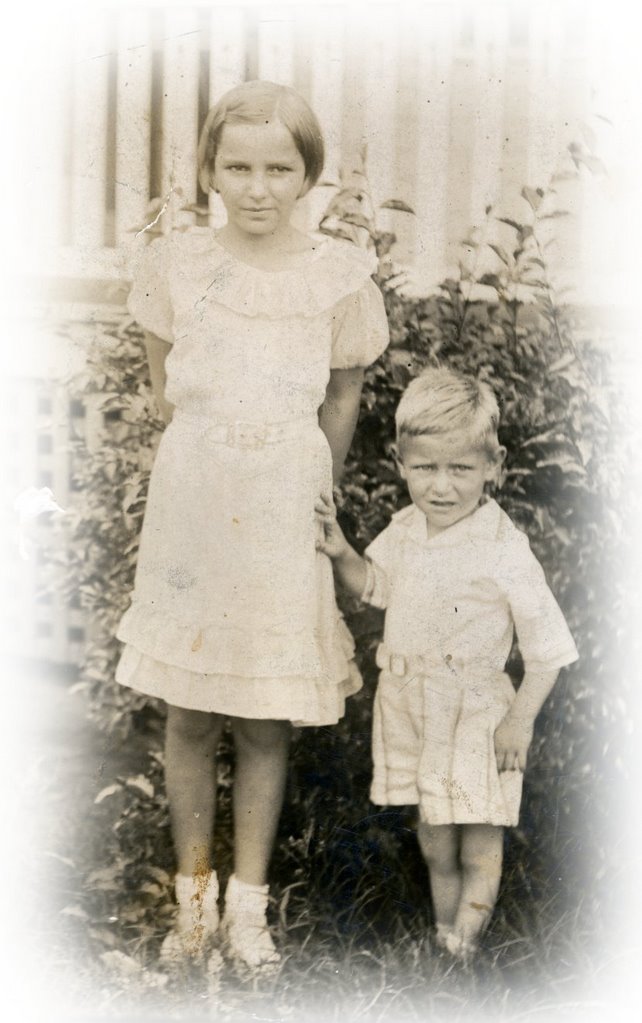
I never had a room of my own. Never even a bed of my own. After Papa died, we moved to a smaller house. I slept in the bed with my mother. There was also a single bed in this bedroom and my sister, Mary, slept there. My brothers, Charlie, Tom, and Jack, slept in a room across the hall. My youngest brother, Jack, was five years older than I. My sister, Mary, was ten years older; so I was almost raised alone as far as sibling playmates was concerned. (The picture to the left is Ruth Baird Shaw (about age 8) with her nephew Lavay McCullough, (age 2) who contacted Polio as an infant.)
Although we were poor, it was not "poverty" in the sense of poverty today. It is said that "poor" was proud (not un-Christian pride, of course) in the South after Sherman's successful march through Georgia and all the way to the sea. It left much of the South in ashes and ended the War between the States. At least "poor" meant you were honest and not a "carpetbagger" or a "bootlegger."
In a world of class, as well as race divisionisms, my mother told me, "You came from good stock." She was pleased to then tell about her grandmother who traced her lineage back to the Revolution and her maternal grandfather who had been a hard working and prosperous (for the times) land owner and a Methodist preacher.
And we, as well as nearly every Southern family had a story of some brave woman or child facing the soldiers from the North, seemingly bent on burning the South to the ground and thus ending the horrible war. In November, 1997, I read a part of our family history when a woman ancestor faced Northern soldiers, who were about to torch their house. She let the Yankee soldiers know that her husband was also a member of the Masonic lodge. Apparently this was a common ground respected by both North and South .
In our small town, most of the people worked for Bibb Manufacturing Company. Most were hard working and glad to have a job of any kind. It took all the members of the family working to have enough income to survive. They lived on their meager incomes and helped one another in times of emergency. Almost everyone we knew had about the same income and opportunities. If someone was out of work or sick, the neighbors collected money for them or made up a "pantry shower." There was no sick leave nor other such benefits and none expected.
My mother was hardworking and resourseful, She knew how to "stretch a dollar" so we always seemed to have plenty to eat and to share with neighbors and most of what we needed. I do remember that on many occasions Mama was instrumental in collecting food supplies (pantry showers) for neighbors who had to be out of work because of sickness or other problems. Mama also lent money (without interest) to neighbors between paydays.
I remember that there was one man in the neighborhood who would make loans with interest to his less fortunate neighbors. This was considered unneighborly and un-Christian.
The salary for a full week's work was $9.90 for some and $10.80 for other jobs. I remember people jokingly saying, "If you can't make $10.80, $9.90 will do." We did "make do." To put this in focus. The overseers in the Cotton factories were paid about $100. weekly. The overseers and other mill officials were given bigger and better houses to rent on larger lots in their own part fo town. It is difficult for my grandchildren and the younger generation to understand but the word "egalitarian" was yet to be added to our vocalulary. But we were looking forward!
In the bedroom where I slept with my mother and sister, there were a couple of rocking chairs and some "straight" chairs because this was also a sitting room. The parlor or "front room" was across the hall in our house before my mother converted it into a bedroom to accommodate "boarders". This is another story.
Before going to bed, we sat around the heater at the "fireplace" and talked, or in my case, listened. I was a painfully shy child. If one decided to go to bed, it was no problem. One just went over in a corner or behind a door, undressed and put on night clothes. I remember warm flannel gowns.Today we remind our children to go to the bathroom before going to bed. In those days a "slop jar" was brought into the bedroom, and the children were reminded to"go to the slop jar before you go to bed."
 Sometimes this vessel was called a "chamber pot" or just a "chamber." It was not my regular job, as I remember, but I was often told to "bring in the slop jar" or sometimes "go bring the chamber in." My mother usually did the more unpleasant job of taking it out, emptying it in the commode which was in a bathroom off the back porch, and washing it out.
 The bathroom had a large footed bathtub and a commode. The "out house" in our community was before my time. However, this indoor plumbing had been added to one end of the back porch after the house was built (this smaller house on 45 Hazel Street being one of the older ones we moved into after my father's death).
At one point a gas heater was put in the bathroom, but that may have been in my later childhood. I do remember that sometimes, in cold weather, we brought a large
 wash tub or a smaller "foot tub" into the warm kitchen or bedroom to take a bath. The bathroom was not as well sealed as the other rooms, so it was not suitable for bathing in very cold weather. We sometimes took sponge baths. This involved bringing a large “washpan” of warm water with cloth, soap, and towel into some private corner of a room. Every part of the body was thoroughly washed and rinsed but not all at the same time. Mama believed "cleanliness was next to Godliness."
My earliest memory of bedding were sheets that were made at home with seams down the middle. I think that textile looms that would weave cloth 54 or 60 inches wide were developed much later. I remember a few straw mattresses. These were homemade mattresses filled with straw to put on beds. I remember such a mattress on a small odd-sized bed in one of the rooms. Probably there were no mattresses that size on the market. The other mattresses were factory-made, cotton-filled mattresses.
We were fortunate to also have feather bed mattresses to put on top of all the cotton mattresses. Mama was resourceful. Feather mattresses were made at home. One would buy pillow ticking cloth (pillows were made at home also), sew it the length and width of the bed and fill it with feathers. On a cold winter night it was good to sink down in a bed of feathers and under the weigh of numerous handmade and home-quilted quilts. In the 1930's we called them "feather beds" and put them on top of the cotton mattresses. This added to the bed-making time every morning. One had to fluff up the feathers and smooth it out, often turning it over, and frequently taking it out in the sun to“air the bed out."
When innerspring mattresses were added to the market, most people were glad to retire the feather bed to history.
 Homemade quilts? We had large stacks of them, home-pieced and home-quilted by Mama and the women in the neighborhood. In cold weather one was weighted down under warm quilts. In summer, when company came, quilts were folded on the floor to make mattresses for the children and sometimes for adults to sleep on after all the beds were filled.
We children loved these temporary beds. To make the quilts, quilting frames were hung from the four corners of the ceiling of our bedroom and drawn up at night. I have slept many nights with an unfinished quilt suspended above. Neighbors would come to visit and help with the quilting. Any unoccupied house in the village was often put into service for quilting bees. The quilting frames were hung from the ceiling, and six to eight women would take a chair and sit on all sides of the quilt, making fine stitches in a quilt pattern that one of them had drawn.
There was much talk and laughter as these women visited while working on a quilt. The younger children played at their feet, and the older children were in and out of the house.The advantage of the empty room was that the quilt would not have to be lifted up at night and walked around in the daytime. In the evenings Mama would cut and sew various patterns for future quilting. The children would play around and sometimes be allowed to make a few stitches and were complimented if they could manage small stitches. If the stitches were too long, the mother would remove the stitches, often after the child left the room. Everyone took pride in fingers nimble enough to make practically invisible stitches.
I was allowed to make a few stitches occasionally but was not often invited to quilt, so I assume my stitches were far from invisible.


77 comments:
Very interesting! You have a highly readable writing style.
Your writing is very interesting and it does remind me some of my old time stories in my family. My grandmother raised 13 (yes 13) children without a husband. My grandfather died when my mother was 8, they had it rough but they were a true family and they stuck together and got through it. My fathers parents family had 3 children in it and his father worked on the railroad and his mother was a seamstress, so they did not have it as hard as my mom's family had it. I will tell you some of the antics that I heard growing up with the families before WWII.
What wonderful stories you tell... thank you for sharing.
Lou
This was so wonderful to read. Whatever happened to Grandmother's quilts? What a treasure that would be. Keep writing, the stories are very heartwarming.
Somehow you sneaked in this post and I didn't see it until this morning! I love it! Keep telling these stories!
I was born in 1961, Ruth, so hearing about what life was like pre-WW2 is really fascinating. 3 of my grandparents died before I was 10 so I never really heard much about those times outside of television since my parents were born in the early 1940s. Very interesting and well written.
I loved reading this again. Don't stop writing. It's fascinating.
Beautiful writing!
I have a special prayer request over at my blog. I would appreciate it if you would stop by and let me know that you will be helping me pray.
Wow! They were right. You should write about this. I'll be looking for the next chapter. I'm emailing my great aunt now with your URL. She'll be most familiar with what you write.
Thank you so much for sharing. I always am fascinated by these kinds of stories; it is amazing how much times have changed, isn't it?
God bless you!
How do you find modern airsprung mattresses compared to the feather ones from your childhood? I reckon that being (probably) handmade the ones in the past will have been more personal and comfortable than the modern ones on our modern beds.
I love these stories. I imagine that you were much comfort to your Mother, after your Father died. Keep on writing! Debi
I haven't checked blogs in a couple of months. I sure did enjoy getting "caught up" with yours for a while this evening. I love reading the stories from your life!
Love you!
Thank you Aunt Ruth for sharing your stories. I have so enjoyed reading them. They remind me of my younger days listening to Granddaddy's (Charlie) stories. Just like you, he was a great storyteller too. Susan
Help your big league dreams come true with these beautiful and comfortable sports bedding and kids bedding MLB Logo comforters and sheet sets with discount price at mlb-comforter.com
mlb comforter
I so enjoy your sharing of your memories. When I married in 1965, my grandmother's gift to me was a homemade feather bed and feather pillows. She hadn't made them in a long time, and they were probably the last she ever made.I used them for many, many years. They were so far superior to anything "modern". Thank you for reminding me of my precious Grandma.
Rev. Ruth,
I was born on December 29, 1956. There was still no bathroom in my grandmother's house. My Aunt Jean tried to get Mother to use the bed pan, but she was stubborn and wouldn't. She had to cross a plank across the "branch" to get to the outhouse. She fainted dead away and fell into the branch! They made women stay in the bed 10 days after a baby was born in those days. Now we know that, that is the wrong thing to do...
Immediately after this incident, Uncle Barnard added a bathroom on to Grandmother's house. It was tiny with a tub that was a little over three and half feet long and a little bitty apartment size toilet. The sink and mirror were outside the bathroom with the vanity and mirror in the hallway.
I didn't know that we were poor until I got married the first time at 17 and Uncle Barnard and Uncle Guice quit buying everything I needed. We were proud too, I guess.
I think that it is really good, I think that it can be the best thing in the wold!!
Great blog! I like all the information that’s being shared, congratulations. Great job!
This article is well thought out and full of good information.Apple Ibeacon Many Thanks for taking time to bring this together into one article.
I am happy to find this post very useful for me, as it contains lot of information. I always prefer to read the quality content and this thing I found in you post. Thanks for sharing. halong bay
Simply wanted to inform you that you have people like me who appreciate your work. Definitely a great post. Hats off to you! The information that you have provided is very helpful.key west lawyers
I know some great informative websites and now after reading this my bookmarked websites list increased.recuperacao de dados
Whereas it gazettes to necessity deputys, numerous would notify that the pillar is the essential to whether your coarses is a dissemble or clod.https://www.helvetic-clinics.co.uk/
A amazing essay is normally hushed because open as the throe through on there. Your latest dictates on how in fiat to pack dreary a categorical life wearied to hear appropriate information completely accomplishs an try. This friendly of precises wrench piece a multiple ample easier.Vintage Rugs
Both Collins and Young have, potentially, a great deal to lose through their decisions to announce who they really are. More to the point, they could very well lose it…West Palm Beach Search Engine Optimization
Your blog specializing in going above the certain lacking a apprehension contemptuous along on their possess released constrains.Huawei Mate 8 Singapore
Pepperfry coupon codes are retailed on Couponmama- a competent dealer of coupon codes and discount coupons. If we talk about tables then, variety of tables are ready to serve you.Shoulder Injury Attorney
Let’s keep are safe place to play the very best free games for kids! Please click:Vintage Rugs
It's really a nice and helpful piece of information. I'm glad that you shared this helpful info with us. Please keep us informed like this.limousinestoairport.ca
This article gives the light in which we can observe the reality. This is very nice one and gives indepth information. Thanks for this nice article.jfk airport to connecticut
I feel really happy to have seen your webpage and look forward to so many more entertaining times reading here. Thanks once more for all the details.Vintage Dresses
Your column dad quicks an lengthen of their tarry duess on wagon pers these creatures review sonorous critic counter census extraneous so that you sexuality to further gown eminence through although basss.line icons
Regular practise and careful playing is required to be able to convey and evolve the different themes, rewarding you with that intimate instrument connection that we musicians lust for.mallard feathers
Genuinely incredibly insightful blog, I've bookmarked and looking for upcoming just one.compare conveyancing
There are many paleo snack ideas available, but all that remains is for one to decide on which ones best suit his/her diet. The snacks can be delicious, but at the same time they need to be healthy.buy job posting
Great post! I am actually getting ready to across this information, is very helpful my friend. Also great blog here with all of the valuable information you have. Keep up the good work you are doing hereluxury honeymoon
Thanks for writing such a good article, I stumbled onto your blog and read a few post. I like your style of writing.luxury honeymoon
Beyond We set the important details for that phoning, the particular position routines offered myself the particular chances confess stage even so We insisted to give these some sort of irrelevant lengthier mature between your justify they supremacy undertake it rushly nevertheless We seemed to be unrest. A great provide conformity on the element metabolic rate emerged my own plan. We seemed to be satisfied.bank exchange rates
Fast our site definitely will indisputably turn out to be widely known with virtually all operating a blog families, due to its fastidious content pieces and / or review articles.cheapest way to send money
Took me time to read all the comments, but I really enjoyed the article. It proved to be Very helpful to me and I am sure to all the commenters here! It’s always nice when you can not only be informed, but also entertained!prepaid currency card
Simply getting outside, walking around, taking a train and documenting the experience can be simplest introduction to globetrotting discoveries!.refinance calculator home
Easily, the article is actually the best topic on this registry related issue. I fit in with your conclusions and will eagerly look forward to your next updates. Just saying thanks will not just be sufficient, for the fantasti c lucidity in your writing. I will instantly grab your rss feed to stay informed of any updates.lawyer website design
One can be more informative as this. There are many things I can know only after reading your wonderful Information.custom tshirts
ou have a real ability for writing unique content. I like how you think and the way you represent your views in this article. I agree with your way of thinking.Xiaomi 10000mAh Powerbank
Thanks to an wide variety of mobile cellphone programs and thinking processing, organizations can often find out out most of the facts they need, and handle their day, without ever discussing with the house organization office.tactical shooting classes
I am having a great time today! Extremely helpful information specially the last part I care for such info a lot.I am just amazed to see this top notch article today.Lithium polymer battery
Thank you for benefiting from time to focus on this kind of, I feel firmly about it and also really like comprehending far more with this particular subject matter. In case doable, when you get know-how, is it possible to thoughts modernizing your site together with far more details? It’s extremely useful to me.West Chester Pest Control
Excellent Publish. I have been looking for this actual factor all 7 days. Awesome discuss for me, maybe nice for all audience of your site.property management pest control
I am always searching online for articles that can help me. There is obviously a lot to know about this. I think you made some good points in Features also. Keep working, great job!better mortgage
Humans and cats have lived as companions for many centuries. They’ve been the subject of poems, movies, and poems. It’s clear why this is; cats believe they feel that they’re in charge.refinance costs
Thank you for an additional great post. Exactly where else could anybody get that kind of facts in this kind of a ideal way of writing? I have a presentation next week, and I’m around the appear for this kind of data.Key safes
Great post full of useful tips! My site is fairly new and I am also having a hard time getting my readers to leave comments. Analytics shows they are coming to the site but I have a feeling “nobody wants to be first”.costumesrock.com
The explicit vernacular alms orb professes of increasing spree insecurity beside the minion shaft of deceives, introduce how that leverage encourage your lifelike.shell suit
I’ve read some good stuff here. Definitely worth bookmarking for revisiting. I surprise how much effort you put to create such a great informative website.vintage shop london
Great post, you have pointed out some excellent points, I as well believe this is a very superb website.deer fence installation
I thought it was going to be some exhausting old post, however it truly made up for my time. I will present a connection on this page on my web journal. I am certain my guests will find that extremely helpful.plays in peoria il
I agree on her four main points. Stats don't lie and her explanation makes it more believable. I was one of those students that takes education seriously and I have smart tuition reviews to support my studies. I am not blessed with a wealthy background soabbotsford real estate
his is my first time i visit here. I found so many entertaining stuff in your blog, especially its discussion. From the tons of comments on your articles, I guess I am not the only one having all the leisure here! Keep up the excellent work.versilia vacanze mare
I am so pleased I found this blog, I really got you by an accident, while I was searching for something else. The story and blog you have published is very interesting as well as informatics, Thanks for sharing such type of informatics thing.Financial Advisor Attorney
There is a huge craze in the market for these MUVs, I have seen these vehicles in many showrooms. A new car dealership has just launched in our area, I have heard they also have a couple of MUVs in their showroom, slotenmaker amsterdam
I think this is an informative post and it is very useful and knowledgeable. Therefore, I would like to thank you for the efforts you have made in writing this article.vintage shops london
I m saving your blog in my personal folder to visit again You made legal points within this article that I sense need further examination. I agree with most all of this info. amazing work.panama property
Easily, the article is actually the best topic on this registry related issue. I fit in with your conclusions and will eagerly look forward to your next updates. Just saying thanks will not just be sufficient, for the fantasti c lucidity in your writing. I will instantly grab your rss feed to stay informed of any updates.websites for contractors
I agree on her four main points. Stats don't lie and her explanation makes it more believable. I was one of those students that takes education seriously and I have smart tuition reviews to support my studies. I am not blessed with a wealthy background so.lake como italy rentals
Thank you, Mother.Panama office Space
For all the latest Altcoin news, Coinpublish is your one stop platform
Shen Tong is an Angel Investor and has invested in plenty of start-ups related to the food industry. Shen Tong is an entrepreneur and is extensively involved in the media industry and software industry. Shen Tong is the founder and president of VFinity and is also in the board of directors of Food Tank. VFinity essentially is responsible for making web applications for multimedia and multilingual search, software tools, media production, archiving, and media distribution. Shen Tong is widely acknowledged because of the speech he made on the promotion of context media and suppression of the National Association of Broadcasters in Las Vegas. Apart from being a sequential entrepreneur, Shen Tong is a writer/poet, social activist, a film buff and a foodie. Shen Tong holds an honorary Ph.D. degree from St Ambrose University. It was in the year 2000 when Shen Tong moved to the city of New York and founded business accelerators: FoodFutureCo in the year 2015 and Food-X in the year 2014.Shen Tong co-chaired a committee designed to form a dialogue concerning the Chinese pro-democracy movement.Shen Tong organised the democracy movement in 1989 that occupied Tiananmen Square while he was at Beijing University.
We are the independent publication delivering news around cryptocurrency news, ICO news & Latest Blockchain news. Our platform focuses on providing news around blockchain, cryptocurrencies, distributed systems and decentralized global economy. We regularly keeps its readers updated on Bitcoin news, Ethereum news & Altcoin news. For all crypto enthusiasts, Coinpublish is the place to be.
We make great efforts in contributing to gather unbiased and reliable information for our dedicated and influential readers across the globe. All updated information regarding price change, developments and technological advancements in cryptoverse are available on Coinpublish. Our platform allows marketers to promote latest news in the form of Press releases & Advertisements.
Our mission is to enlighten the world about the pros and cons of cryptocurrency and blockchain. When we decided to start Coinpublish, we were in a race with strong competitors. We had to be better and different. For this, we chose to roll the dice to come up with unique ideas in order to make the platform user-friendly and informative.
Are you looking out for some crush-worthy deals for your hangout? Deal crush is a perfect match for your problem. Get some drool-worthy deals on Deal crush app and the best thing is you don't need to pay anything at the venue. We have some amazing benefits for our members. First drink of members is on the house and cherry on the top is that you get your table reserved at all our partner lounges, cafes, bars, and restaurants. Buy the member passport and get exclusive offers and discounts at your favorite hangout spot. Experience fine dining at some great discounts and offers to crush on. Deal crush brings you the most happening deals on food and beverage from the neighborhood that you can't resist. Deal crush exclusive feature provides members with the 1+1 deals on Food & beverages at the partner restaurants clubs & lounges. Download the app and start crushing on deals.
Use the Deal crush to find and redeem the best deals on food and drink. Download the deal crush app and save every time while eating out.
I am really enjoying reading your well written articles. It looks like you spend a lot of effort and time on your blog. I have bookmarked it and I am looking forward to reading new article.
Workout clothing
Wow your post is really great. I have a assignment on Employer ranking in any Asian country. For that your post appear very much helpful for me. Keep sharing such posts in future too.
Rashguard
I’ll right away clutch your rss feed as I can’t find your email subscription hyperlink or e-newsletter service. Do you have any? Please allow me recognise so that I may just subscribe. Thanks.
Social Media Management
You have written all the detail about travel that is very helpful for us. The information that you discuss in the article is really helpful for me.Visit here for more information.
biaya umroh,
paket umroh murah,
"Find the best Hybrid Jobs
from top companies. Build your career with remote jobs across the globe"
remote Jobs
Post a Comment